
Rotary vs. Through-Feed Grinding: How Parts Move
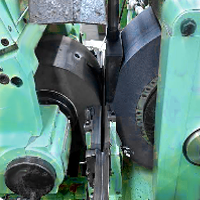
Through-feed grinding pushes parts in a straight line between two opposing wheels. Rotary feed carries them through the gap in pockets on a turning carrier. Both move flat parts through a double disk grinder, and both finish two faces at once. The difference is how the part is held and how it travels. That affects which shapes run well, how fast a lot moves, and how consistent the parts come out.
Buyers rarely specify a feed method on a print, and they should not have to. Still, the difference explains why one supplier quotes a part easily while another says it does not fit. At Northern Industrial Manufacturing, we grind flat, single-layer parts for automotive drivetrains. Part shape is one of the first things we look at on a new print.
Through-Feed Grinding Moves Parts Continuously
Through-feed grinding is the simplest path between the wheels. Parts enter one side of the gap, travel across the wheel faces, and exit the other side.
How Through-Feed Grinding Guides Parts
In through-feed grinding, guides, rails, or a belt keep parts in line as they cross the wheel faces. The wheels sit at a slight angle, so the gap narrows from the entry side to the exit side. Stock comes off gradually as the part travels. The part leaves at the thickness the exit gap sets. Nothing clamps the part. It is simply carried through, which keeps added stress low.
Parts That Suit Through-Feed Grinding
Round parts with clean outlines travel best in through-feed grinding. Shims, washers, and spacers roll or slide through the gap without catching. Parts that are reasonably stiff for their size hold position well. Because parts follow each other closely, throughput runs high. That suits programs making hundreds of thousands of pieces a year.
Rotary Feed Differs From Through-Feed Grinding
Rotary feed reaches the same result by a different path, and the trade-offs are worth understanding alongside through-feed grinding.
Rotary Carriers Replace Through-Feed Grinding Guides
A rotary carrier replaces the guides that through-feed grinding relies on. It is a plate with pockets cut to match the part. Parts drop into the pockets. The carrier turns, and each part swings through the gap between the wheels. The pocket controls where the part sits, so the carrier handles shapes that would wander in a straight line. Every pocket presents its part to the same section of the wheels, which keeps a lot consistent.
Rotary Feed Compared With Through-Feed Grinding
Rotary feed usually costs more to set up, because the carrier has to match the part. It also cycles in steps rather than a steady stream. On simple round parts, throughput can fall below through-feed grinding. In exchange, it holds odd shapes steady and gives more control over how each part sits in the gap.
Part Shape Decides Through-Feed Grinding Fit
Shape matters more than size when a supplier decides whether through-feed grinding will work.
Tabs and Odd Outlines Limit Through-Feed Grinding
Tabs, notches, and irregular outlines can catch on guides or turn as they travel. That limits through-feed grinding. A lock plate with an anti-rotation tab is a common example. Parts like these run better in a rotary carrier, where a pocket holds the outline in place. If a part has a feature that sticks out, mention it early. The supplier can then plan the right approach.
Thin Parts and Large Bores in Through-Feed Grinding
Thin rings with a large inner diameter flex more than solid disks. There is less material to resist movement. In through-feed grinding they can chatter or ride unevenly. Thicker parts, or parts with more material across the face, travel more predictably. Our line handles parts from 0.060 to 0.200 inch thick and up to 6 inches in size. Geometry near those edges deserves a look before tooling is built.
Stamped Blanks Entering Through-Feed Grinding
What happens in the press decides how smoothly a part travels through through-feed grinding.
Blank Flatness Before Through-Feed Grinding
Cutting a blank in a die traps stress in the metal. A part that reaches through-feed grinding out of flat does not ride evenly. A part with a noticeable bow does not sit evenly across the wheel faces. The first pass takes more stock off the high spots. Compound tooling helps. It cuts the outside and inside features in a single stroke while holding the part, which produces a flatter blank. A flatter blank means less stock to remove and a steadier trip through the gap.
Stock Allowance for Through-Feed Grinding
Stock allowance is the extra material left on the blank for through-feed grinding to remove. Too little, and some parts will not clean up on both faces. A dull patch shows where the wheel never touched. Too much wastes grinding time, wears the wheels faster, and raises cost on every piece. One supplier that stamps and grinds can pick the coil thickness and the allowance together. That is harder when two companies each quote their own step.
Automation Around Through-Feed Grinding
The wheels are only part of the picture. How parts are loaded and collected shapes the real output of a through-feed grinding line.
Feeding and Collecting Parts in Through-Feed Grinding
Parts enter the gap by hand or by automated equipment. They have to be collected just as carefully on the way out. Automated feeding keeps the wheels cutting between operator checks, raising output on long runs. It also cuts handling, and every handling step risks a nick, a scratch, or a mixed lot. Freshly ground steel marks easily. How parts leave a through-feed grinding line matters as much as how they enter.
Keeping Lots Separated After Through-Feed Grinding
Selective fit families leave through-feed grinding in thickness steps that look identical to the eye. If two steps land in the same container, the mistake may not surface until an assembly fails a test. Clear labeling, separated containers, and color coding on the outside diameter keep steps apart. Parts stay sorted from grinding through finishing and packaging. Keeping those operations in one plant removes several of the handoffs where a mix-up could happen.
Volume & Cycle Time in Through-Feed Grinding
Through-feed grinding shows up directly in cost per part, because feed rate sets how many parts cross the wheels in an hour.
Through-Feed Grinding Suits High Volumes
A steady stream of parts keeps the wheels cutting almost continuously. That is why through-feed grinding fits programs with high annual volumes and stable demand. Our programs start above 5,000 pieces per year and run into the hundreds of thousands annually. Continuous feeding is a large part of what makes that practical.
Changeover Time Between Through-Feed Grinding Jobs
Every through-feed grinding job change means setting the gap and verifying first pieces. The run continues once the process is confirmed. Frequent small lots mean more changeovers, and each adds cost. Fewer, larger lots spread that setup across more parts. A blanket order with scheduled releases usually balances run efficiency against inventory.
Quality Control in Through-Feed Grinding
Through-feed grinding affects how parts are checked as much as how they are moved.
Watching Wheel Wear During Through-Feed Grinding
Wheels wear as they cut, and the gap can drift with them. Operators check parts through the run and dress the wheels, meaning they true the cutting face. That keeps the gap where it belongs. On a long through-feed grinding run, those checks keep the last part matching the first.
Measuring Parts From a Through-Feed Grinding Run
After a through-feed grinding run, thickness is measured at several points across the face. A single reading can hide variation. Flatness is checked in the free state, resting on a surface plate with nothing holding the part down. We test thickness, flatness, parallelism, hardness, and surface finish through production. Our line holds a 0.001 inch total thickness tolerance, with flatness and parallelism at 0.001 inch.
What Buyers Should Ask About Through-Feed Grinding
You do not need to specify through-feed grinding on a print. Still, a few questions reveal whether a supplier has thought about your part. Ask how the part will travel between the wheels. Ask whether its shape risks catching or tilting. Ask what happens to thin sections or tabs. Ask how often parts get checked during a run, and how wheel wear is managed. Clear answers usually mean the supplier has run something similar. Vague answers are worth noticing before a program launches.
Matching Your Part to Through-Feed Grinding
Through-feed grinding and rotary feed both deliver the core benefit of double disk grinding. Two faces finish at once, with balanced forces. Round, stable parts in high volumes tend to favor through-feed grinding. Odd outlines and parts that need extra control often favor a rotary carrier. The right answer comes from the part, not from a preference.
US Through-Feed Grinding Manufacturer
Northern Industrial Manufacturing grinds flat carbon steel parts in SAE 1008 through SAE 1095, hardened or not. Our US IATF 16949 certified plant sits in the Detroit area. Send us your print. Our team will tell you how your part should travel between the wheels, and what that means for cost and lead time.
Precision US Through-Feed Grinding Manufacturer: 586.468.2790
Thank you for visiting our blog where we keep you updated on the latest News and Events in automotive manufacturing!
Please check back often to learn what is going on with Northern Industrial Manufacturing, in the world of precision thrust washers, selective shims, and spacers.
Through Feed Grinding
Rotary vs. Through-Feed Grinding: How Parts Move
Through-feed grinding pushes parts in a straight line between two opposing wheels. Rotary feed carries them through the gap in pockets on a turning carrier. Both move flat parts through a double disk grinder, and both finish two faces at once. The difference is how the part is held and how it travels. That affects which shapes run well, how fast a lot moves, and how consistent the parts come out.
Buyers rarely specify a feed method on a print, and they should not have to. Still, the difference explains why one supplier quotes a part easily while another says it does not fit. At Northern Industrial Manufacturing, we grind flat, single-layer parts for automotive drivetrains. Part shape is one of the first things we look at on a new print.
Through-Feed Grinding Moves Parts Continuously
Through-feed grinding is the simplest path between the wheels. Parts enter one side of the gap, travel across the wheel faces, and exit the other side.
How Through-Feed Grinding Guides Parts
In through-feed grinding, guides, rails, or a belt keep parts in line as they cross the wheel faces. The wheels sit at a slight angle, so the gap narrows from the entry side to the exit side. Stock comes off gradually as the part travels. The part leaves at the thickness the exit gap sets. Nothing clamps the part. It is simply carried through, which keeps added stress low.
Parts That Suit Through-Feed Grinding
Round parts with clean outlines travel best in through-feed grinding. Shims, washers, and spacers roll or slide through the gap without catching. Parts that are reasonably stiff for their size hold position well. Because parts follow each other closely, throughput runs high. That suits programs making hundreds of thousands of pieces a year.
Rotary Feed Differs From Through-Feed Grinding
Rotary feed reaches the same result by a different path, and the trade-offs are worth understanding alongside through-feed grinding.
Rotary Carriers Replace Through-Feed Grinding Guides
A rotary carrier replaces the guides that through-feed grinding relies on. It is a plate with pockets cut to match the part. Parts drop into the pockets. The carrier turns, and each part swings through the gap between the wheels. The pocket controls where the part sits, so the carrier handles shapes that would wander in a straight line. Every pocket presents its part to the same section of the wheels, which keeps a lot consistent.
Rotary Feed Compared With Through-Feed Grinding
Rotary feed usually costs more to set up, because the carrier has to match the part. It also cycles in steps rather than a steady stream. On simple round parts, throughput can fall below through-feed grinding. In exchange, it holds odd shapes steady and gives more control over how each part sits in the gap.
Part Shape Decides Through-Feed Grinding Fit
Shape matters more than size when a supplier decides whether through-feed grinding will work.
Tabs and Odd Outlines Limit Through-Feed Grinding
Tabs, notches, and irregular outlines can catch on guides or turn as they travel. That limits through-feed grinding. A lock plate with an anti-rotation tab is a common example. Parts like these run better in a rotary carrier, where a pocket holds the outline in place. If a part has a feature that sticks out, mention it early. The supplier can then plan the right approach.
Thin Parts and Large Bores in Through-Feed Grinding
Thin rings with a large inner diameter flex more than solid disks. There is less material to resist movement. In through-feed grinding they can chatter or ride unevenly. Thicker parts, or parts with more material across the face, travel more predictably. Our line handles parts from 0.060 to 0.200 inch thick and up to 6 inches in size. Geometry near those edges deserves a look before tooling is built.
Stamped Blanks Entering Through-Feed Grinding
What happens in the press decides how smoothly a part travels through through-feed grinding.
Blank Flatness Before Through-Feed Grinding
Cutting a blank in a die traps stress in the metal. A part that reaches through-feed grinding out of flat does not ride evenly. A part with a noticeable bow does not sit evenly across the wheel faces. The first pass takes more stock off the high spots. Compound tooling helps. It cuts the outside and inside features in a single stroke while holding the part, which produces a flatter blank. A flatter blank means less stock to remove and a steadier trip through the gap.
Stock Allowance for Through-Feed Grinding
Stock allowance is the extra material left on the blank for through-feed grinding to remove. Too little, and some parts will not clean up on both faces. A dull patch shows where the wheel never touched. Too much wastes grinding time, wears the wheels faster, and raises cost on every piece. One supplier that stamps and grinds can pick the coil thickness and the allowance together. That is harder when two companies each quote their own step.
Automation Around Through-Feed Grinding
The wheels are only part of the picture. How parts are loaded and collected shapes the real output of a through-feed grinding line.
Feeding and Collecting Parts in Through-Feed Grinding
Parts enter the gap by hand or by automated equipment. They have to be collected just as carefully on the way out. Automated feeding keeps the wheels cutting between operator checks, raising output on long runs. It also cuts handling, and every handling step risks a nick, a scratch, or a mixed lot. Freshly ground steel marks easily. How parts leave a through-feed grinding line matters as much as how they enter.
Keeping Lots Separated After Through-Feed Grinding
Selective fit families leave through-feed grinding in thickness steps that look identical to the eye. If two steps land in the same container, the mistake may not surface until an assembly fails a test. Clear labeling, separated containers, and color coding on the outside diameter keep steps apart. Parts stay sorted from grinding through finishing and packaging. Keeping those operations in one plant removes several of the handoffs where a mix-up could happen.
Volume & Cycle Time in Through-Feed Grinding
Through-feed grinding shows up directly in cost per part, because feed rate sets how many parts cross the wheels in an hour.
Through-Feed Grinding Suits High Volumes
A steady stream of parts keeps the wheels cutting almost continuously. That is why through-feed grinding fits programs with high annual volumes and stable demand. Our programs start above 5,000 pieces per year and run into the hundreds of thousands annually. Continuous feeding is a large part of what makes that practical.
Changeover Time Between Through-Feed Grinding Jobs
Every through-feed grinding job change means setting the gap and verifying first pieces. The run continues once the process is confirmed. Frequent small lots mean more changeovers, and each adds cost. Fewer, larger lots spread that setup across more parts. A blanket order with scheduled releases usually balances run efficiency against inventory.
Quality Control in Through-Feed Grinding
Through-feed grinding affects how parts are checked as much as how they are moved.
Watching Wheel Wear During Through-Feed Grinding
Wheels wear as they cut, and the gap can drift with them. Operators check parts through the run and dress the wheels, meaning they true the cutting face. That keeps the gap where it belongs. On a long through-feed grinding run, those checks keep the last part matching the first.
Measuring Parts From a Through-Feed Grinding Run
After a through-feed grinding run, thickness is measured at several points across the face. A single reading can hide variation. Flatness is checked in the free state, resting on a surface plate with nothing holding the part down. We test thickness, flatness, parallelism, hardness, and surface finish through production. Our line holds a 0.001 inch total thickness tolerance, with flatness and parallelism at 0.001 inch.
What Buyers Should Ask About Through-Feed Grinding
You do not need to specify through-feed grinding on a print. Still, a few questions reveal whether a supplier has thought about your part. Ask how the part will travel between the wheels. Ask whether its shape risks catching or tilting. Ask what happens to thin sections or tabs. Ask how often parts get checked during a run, and how wheel wear is managed. Clear answers usually mean the supplier has run something similar. Vague answers are worth noticing before a program launches.
Matching Your Part to Through-Feed Grinding
Through-feed grinding and rotary feed both deliver the core benefit of double disk grinding. Two faces finish at once, with balanced forces. Round, stable parts in high volumes tend to favor through-feed grinding. Odd outlines and parts that need extra control often favor a rotary carrier. The right answer comes from the part, not from a preference.
US Through-Feed Grinding Manufacturer
Northern Industrial Manufacturing Corp. flat carbon steel parts in SAE 1008 through SAE 1095, hardened or not. Our IATF 16949 certified plant sits in the Detroit area. Send us your print. Our team will tell you how your part should travel between the wheels, and what that means for cost and lead time.
Precision US Through-Feed Grinding Manufacturer: 586.468.2790
Thank you for visiting our blog where we keep you updated on the latest News and Events in automotive manufacturing!
Please check back often to learn what is going on with Northern Industrial Manufacturing, in the world of precision thrust washers, selective shims, and spacers.
HOURS
Shipping
Monday-Friday: 7:00 am to 3:00 pm
Office
Monday-Friday: 7:00 am to 4:00 pm

CONNECT